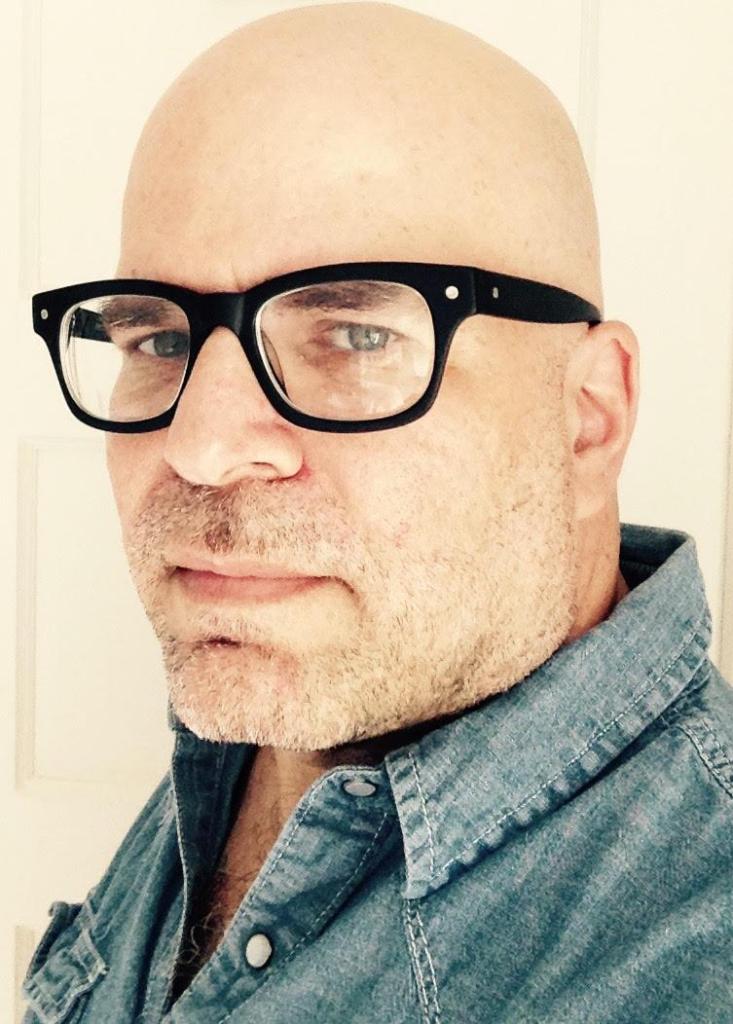
Today, I talk with my former thesis professor and current writing mentor David Greenberg on the use of AI in screenwriting. We’ll go into AI’s applications in film and how it’s viewed inside the screenwriting world. We will also discuss how the stigma or lack thereof for using AI as a tool varies from writer to writer.
J: I figured we could talk loosely about AI, since it’s something we’ve both mulled over quite a bit.
D: It’s a tricky topic. Very tricky topic. And it’s obviously a very highly charged one now with this controversy over Late Night With The Devil and Civil War.
J: As a tool in writing, have you ever used it for anything?
D: Yes. I’ve asked it to write stories for screenplays that I don’t really intend to write. Out of curiosity for what it would come up with. In one case, however, for a script that I’m planning to write later this year, I was talking with the director and we were batting ideas around. We came up with a rough idea of what we want to make a movie about. I put it into AI. I said, write a story about this, and it wrote a story. And I wasn’t crazy about it. And I said, do it again. It wrote another story. I had AI write four stories. Then I showed them to the director. Neither of us liked any of them. But they inspired the story that we eventually did write without AI. I thought that was an interesting case. It jump-started the creative process without replacing it. If we had liked any of those four stories, it would have done the creative process. And I’d have mixed feelings about that. As a writer, I would have felt like I was cheating.
J: If you were struggling to come up with an ending, and after putting it into AI a handful of times you got something you would use, would you feel like that was cheating?
D: I would feel like I was cheating. Because I didn’t do the work. One of the things I like most about screenwriting is the work. A couple years ago I was working on a script and I ran into a problem. It wasn’t bad, but the script wasn’t working. I knew that I had to do some dramatic rewriting. It was hard and complicated to figure out. I’m sitting there, staring at the script, trying to find a way to take these three scenes on page 75 and make them be on page 35 without messing things up. And I remember, even though it was intense, and my brain was blowing up, I was still able to separate myself from the whole process, look down on it, and say, this is fun. It was one of those moments where I said, “alright, Dave, this is what you do. This is the thing you’re good at.” That was really rewarding. If I had used AI, I would not have had that experience. It would have felt like cheating. But somebody else might say the complete opposite.
J: Another writer might say it’s not cheating?
D: When we’re talking about writers, especially screenwriters, there is an group out there that is not doing it for art, that is not doing it for the love of the medium. It’s, “hey, AI, can you crank out a quick, low-budget horror movie script that I can shoot?” just so they can shoot something. To some people, film is just a commodity. If you’re not looking to be an artist, but you are looking to crank out a film, I can see somebody doing that. I may have told you this story about a couple of years ago when I was sitting with a film distributor who produces films too. And he said to me at dinner, “oh, I have a great idea for a screenplay you could write for me.” And I said, “sure, great. What is it?” because, obviously, I want a job. I want to get paid. He pulls out his phone, scrolls through his pictures, and shows me a picture of a poster for a film. It’s an attractive young woman, in a cheerleader’s outfit, sitting on her butt with her legs spread. The poster just has the word cream pie. And I said, “cream pie…”
J: Wow.
D: I said, “okay, I get it. But what’s the story?” The producer said to me, “I don’t know. That’s your job.” He had come up with a poster for a film that doesn’t exist, that he wants to make because he thinks it will make money. There’s no story, and he wanted to hire me to come up with one. I don’t think we’re talking high art here. In that case, I might have – if the deal went through and he said, “here’s a contract, write the movie Cream Pie,” I might have used AI.
J: I could understand that.
D: Because that’s not something I’m going to… I know I should be ethical, I should be more ethical and precious with my work and my talent… but here’s a case where a guy wants a candy bar. The guy wants a cheeseburger. I’m not going to give him organic beef. I’m not going to give him organic chocolate. He’s not looking for art. So maybe I wouldn’t feel so strongly about it in that case.
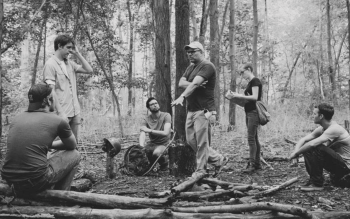
Credit: David Greenberg / University of The Arts
J: It definitely does. I used AI only once, just to see if it could help me with a very minor transition point, and I became very self-conscious because what it suggested wasn’t terrible.
D: Yeah, that’s a tough one. You’re not asking it to write the story, but it is… if it was me, that’s the kind of thing I love to figure out. I call that film math. I’m figuring out that math problem. I enjoy doing that, which would probably keep me from using AI to do it. But I had to do some math the other day. Did I sit down, did I write down the numbers and carry the one and all that stuff? No, I used a calculator. So I don’t know if it’s all that different. My inclination is that the difference is significant because when writing a screenplay, even a beat, even a scene, even part of a scene, it requires you to be creative. It’s all that stuff that I always say in screenwriting classes, that in order to be a screenwriter, you have to be a psychologist, an anthropologist, a sociologist, and a voyeur. I don’t think AI is quite there yet.
J: I’d like to think there are some things AI can’t yet account for.
D: Right. The hard thing about that, too, is that creativity is a living, breathing thing. It’s not an appliance.
J: Do you think there are any angles where the use of AI can be productive?
D: I think there probably are technical applications. It just becomes an ethical bridge that individuals will have to decide whether to cross when it comes to actually writing a story and dialogue with AI. The ethics are so complicated, because we know that the screenwriting business is very often an assembly line and that on big Hollywood films, you can have as many as 30 writers working on a script. Only four will get credit. Once you think about screenplays being written by a committee like that, is it that big an ethical stretch to use AI for writing a screenplay? I wouldn’t do it myself, but it’s really only ethics standing in the way. I know that the tool can do a reasonably good job of it if I want it to. I think there might be some practical or technical uses, how fight scenes and action scenes are mapped out and choreographed using computer-aided design rather than having live bodies that you have to pay for on set.
J: They don’t end up having live people do it?
D: Not in the initial stages, if there’s a fight scene, very often the director, the stunt coordinator, and the fight choreographer sit down and do an animatic using 3D computer design. And once they have it all mapped out, then they bring in live bodies to practice it and rehearse it.
J: I think to your point, I’d almost be more disturbed by a movie having thirty writers than one utilizing assistance from AI.
D: Exactly. That’s what I was getting at. That’s an interesting thing. Nobody has an ethical issue with that. Casablanca is considered one of the best screenplays ever written. There are no less than five writers responsible for it, writing as committee. The interesting thing is, when we talk about ethics, that kind of thing would never fly in the theater. You never have a play written by a committee. There are no ghostwriters in theater. There might be and we never hear about it, but it’s so common in film. I think that points to the differences between the art forms. Theater has been around for centuries, and it has always been primarily human beings acting in front of other people. Whereas film, from the beginning, by nature, is something you make with a machine. I guess the powers that be figured that if you’re already using a machine, you might as well use an assembly line approach to the screenwriting.
If you liked this interview, tune into my blog for more like it, as well as think pieces, lists and reviews. For more on Greenberg, check out his film Stomping Ground on Amazon and Tubi, and follow him on Letterboxd (DavyG) and Instagram (@falseclimax).
 Almost Linear
Leave a comment