
By Jack Davis

Taken on the Schuykill River Trail
Even before I found an academic article to help me better articulate the mixed emotions in my head, I’ve had this sensation gnawing at me to write about the horrific and cringe-worthy past of queer representation in film. I’m bisexual, and it was only after a certain point in my young adulthood that I grew a full understanding of internalized homophobia, and then began to think about the subtle way my environment growing up may have implanted some of that in me.
A big part of that was movies.
Not as many as you might think, given that I watch them every day, but it nonetheless made me realize in hindsight how many movies – both overtly and quietly – looked at queer characters with something of a side eye. Offenders in the racial sense from films in the latter half of the 20th century are more glaring – In Scorsese’s Taxi Driver, the director himself appears in an upsetting scene as a man who’s enraged not just because his wife is sleeping with someone, but because this person is Black (Suffice to say, it’s the choice words this character repeats that provide a lot of the revulsion) – but perception of queer characters took me longer to catch onto. There was a time when I was a younger kid that, after watching so many movies, I sincerely thought any man who was gay spoke in a distinctly feminine way. I’m not proud to say that, but I was a kid who loved watching movies from the ‘60’s and ‘70’s, and that’s a lot of what I was given. The only signal of kinship between the straight main character and a supporting one of queer identification seemed to be if the former didn’t harm the latter.
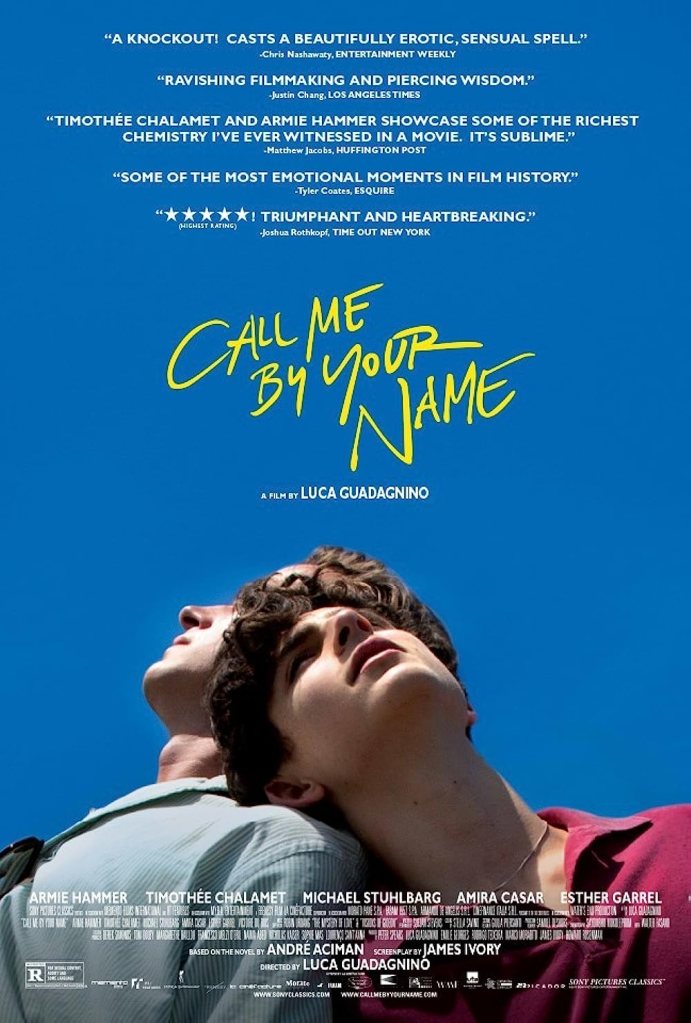
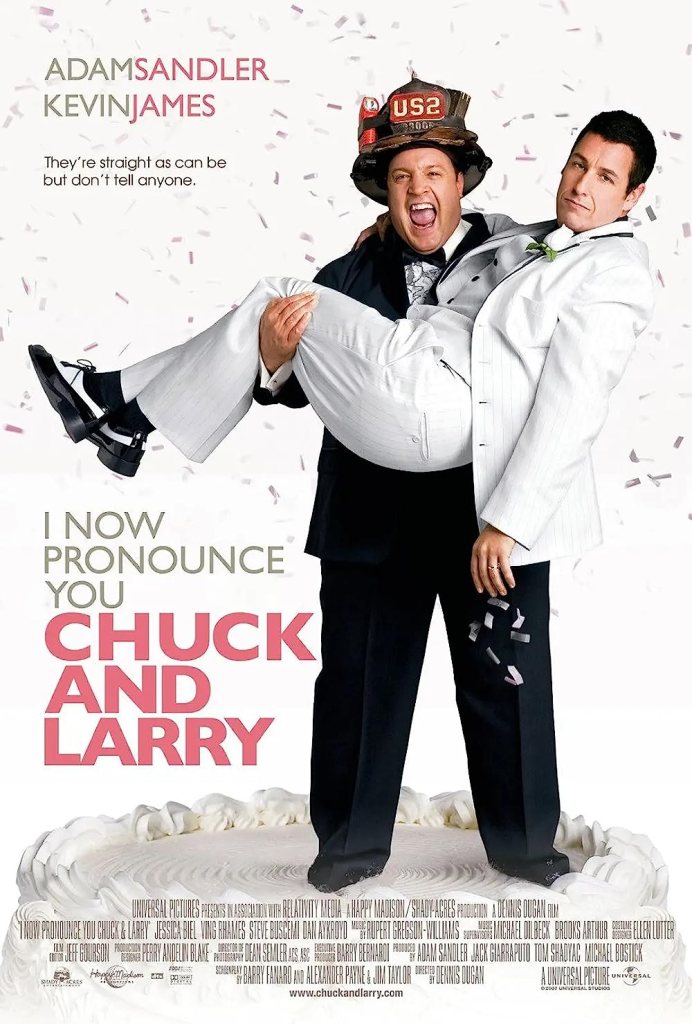
Being conditioned – in my case not by family or close friends, but by my environment – takes some time to unlearn. Being at college has helped; seeing people who are free with the aspects of their identity I found constraining within myself is wholesome. Watching movies where gay characters are the subjects, not antagonists, and the material is treated with care – less of a crapshoot when the director isn’t straight – has given me permission to feel all of my feelings. But for every “Call Me By Your Name,” there’s an “I Now Pronounce You Chuck & Larry,” where gay marriage or just being gay is treated as a joke or a plot device.
I found a piece within Drexel’s – my college at the time of writing this – research database that contained more than a few nuggets of wisdom; this was ‘Screenwriting Representation: Teaching Approaches To Writing Queer Characters.” I’m going to note three points Green made in his opening that helped me process this issue we’re having:
- Part of the reason Hollywood movies–as well as some independent films–seem to take place in a vacuum where social issues and representations of difference are absent is that young screenwriters are basically encouraged to copy other successful movies… As a result, stereotypes and traditional conservative principles–such as the normalizing of heterosexuality and the demonizing of queer sexuality–persist in American movies even as they are being questioned and dismantled throughout our larger culture.”
This is very true, at least in my experience of watching thousands of movies. I don’t think the fact that writers within a decade of my age range write movies like this – ones that at this point feel outside of time – means they’re intentionally part of the problem (or if that’s a productive way to look at young writers). Two words I find think of with queer representation in the past are omission and erasure. For as many movies that exist with offensive, one note depictions of queer characters, there are also stories where:
a) a queer character is written / rewritten in a way that doesn’t allude or alludes minimally to their true sexuality, or
b) in a historical story, there may be queer characters who in real life were consequential to a movement that simply weren’t included in a film.
It happens all the time. A long time ago, it seemed like the extent of gay representation – like I touched on before – was putting a queer character in who essentially says and does nothing but is notably not harmed. That was seen as progress, and I think the straight artistic community thought the queer community should be thankful for even that much acknowledgement.
But I guess I’m straying a bit far from the point, which is that all writers are an amalgamation – in unequal parts – of most things they’ve watched and choose to emulate. It doesn’t mean every young writer is prejudiced, in real life they may be the opposite. I just grab from this section to show that it makes sense why a lot of writers don’t have this instinct to explore and be inclusive; sometimes there’s a motivation to make the next great action movie, and historically there’s never been a badass gay action hero who’s brought in hundreds of millions at the box office. There’s also the very-founded-in-reality fear that a studio will shun the concept, because from what I’ve heard most major studios even today will. I guess it leads one to an internal decision of what kind of writer they want to be; I’m not saying the person who writes the next “Tomb Raider” or “Jungle Cruise” is a sellout, but at a certain point you know what kind of scripts you want to be writing most of the time. For me, I imagine I’ll mostly be writing the scripts that a major studio isn’t going to jump head over heels for, unless I get lucky with some niche-yet-profitable horror feature like Zach Cregger’s ‘Barbarian.’ I would love to write the action movie with a badass main character, but at least today it’d probably be a higher-tier indie feature where I’d self-finance or shop it around to a lot of people before production. A lot of the stuff I write is higher concept, has queer characters and isn’t shameful about it, or both. I’m not saying that in any sort of prideful manner, I’m saying it to demonstrate that I might not find myself courted by studios anytime soon. I’d like to dive into writing broader fare – like I said, though, it’s not what I’d be doing most of the time, quite a few writers alternate to varied degrees – but knowing me it probably wouldn’t be as broad as I intend it.
2. Students also need to be persuaded that such knowledge will help them creatively as well–that it will open up their minds to more possibilities of storytelling and characterization, helping them to avoid the kinds of stereotypes and cliches that offend and bore audiences. … A student may understand act structure, plotting, and the basics of conflict and dialogue, but meaningful, responsible writing extends beyond mechanics to include a lucid perception of the social, cultural, historical, and political implications of the material.
To be fair, the title of this article is not “how to make your scripts more digestible for major studio producers.” I know jack shit about that (no pun intended). I only say what I just said because after reading these two sentences – which are rock solid as far as advice goes, in my eyes – I thought to myself, “this is not gonna help you with some studios.”
What Green says in the first sentence strikes me as very valuable to the future of screenwriting and film. Given some elements of my past, I already have an urge to make sure the queer and alcoholic experience is a part of how I use characterization (when applicable). I’m not saying that “you better have a queer character as the main character in everything you write,” and I don’t think Green is saying that either. I think he’s trying to a) stir awareness in any writers who think the best they can do is imitate old movies, and b) also make them more aware of questionable messaging they may be reinforcing in doing so.
And maybe I’m limiting the scope of this article or losing some readers by focusing on queerness, because that could come off as broad and virtue signaling, urging you to write a movie that “passes the test” on being inclusive but really has nothing to say. That’s not my intention. At the end of the day, I’m saying that the more awareness you have of the history and experience of any groups unlike your own, the more authentic and inevitably less harmful of a product you’re going to put out. Someone could write a story that faithfully represents queer characters but (hypothetically) is painfully unaware of other subjects they’re deciding to touch on in the film. That may raise questions of who should be allowed to write what – which for the most part is a very important conversation – but without getting into the weeds on that, all I wish to say is that knowledge is power. Knowledge of the content’s implications, knowledge of your audience, knowledge of the past and present history of people.
3. “…and most thoughtful, critical viewers, regardless of sexuality, recognize that there is much room for improvement in queer representation. Obviously, queer viewers often “read” film texts differently than straight viewers; however, it is always important not to generalize and not to assume that queer students “know” how to write queer characters and straight students do not (and vice versa). … Engaging these issues in the screenwriting workshop brings them out in the open, leads to important dialogue and collaboration between students of all sexualities, and is an important step in improving queer representation in the cinema.”
I think that this is the perfect anecdote to with, because I think that the point “queer storytelling is important” can quickly be morphed into one about how “straight people are the problem, and they shouldn’t be allowed to write a story that even has a queer character, much less one centered around one.” It’s true that the mainstream studio system was – and for the most part, still is, – controlled by straight white men, and a lot of the messaging under their watch have been reflected in decades of film. But we can’t forget about the fact that there are allies. I’m sure that there are people controlling the flow of entertainment who while straight, sure, are decidedly not homophobic, transphobic, or racist. Same on the writing side. I’m sure many writers were raised right, to be respectful and treat everyone as they’d like to be treated, who though they may not themselves be queer, have a sibling, friend, partner, or parent who identifies as such. I think generalizing a group in any sense always has bad implications, and believe it or not, that applies to how the queer community views straight people too. Not all straight people are rich, white, and homophobic, and a lot of them may be reckoning with this content with a pure heart and good intent, not inserting a vague-as-possible queer character for a cash grab.
This all goes to demonstrate the most important word in this whole anecdote: dialogue. Not in the screenwriting sense, which is also great, but between communities. Ensuring people who don’t share a certain experience aren’t able to touch certain material isn’t a surefire way to ensure quality control. It may be hard for certain writers to admit they’re lacking in their consciousness of the experience of others, but it’s the intention and willingness to learn that are paramount. I don’t have a handbook for how both queer and non-queer communities can be more welcoming to each other, and I’m certainly no spokesperson, but I know what the answer is not refusal to communicate. I also don’t mean to imply that no progress on this has been made, or reinforce the cynicism that there’s no hope for the other group to learn, because there definitely has. I just want to emphasize and repeat the importance of Green’s article in a more recent setting and medium.
I hope that this article was thoughtful and thought provoking, and whether you agree, disagree, or have any questions, please comment.
Don’t be a stranger; I’d love for you to comment with any questions, concerns, or friendly disagreements. Also feel free to reach out to me through the “Contact Me” section of my page. Peace and love!
 Almost Linear
Leave a comment